Overfishing



OBJECTIVE
Students will explore what overfishing is
Students will explore solutions to overfishing
Students will understand overfishing has negative environmental impacts
ESSENTIAL QUESTIONS
How do the food choices we make impact the people and environment?
MATERIALS NEEDED
- Bowls (1 per group)
- Cups (1 per group)
- Sets of chopsticks (1 per group)
- Tape
- Forks (1 per group)
- Large spoon (1 per group)
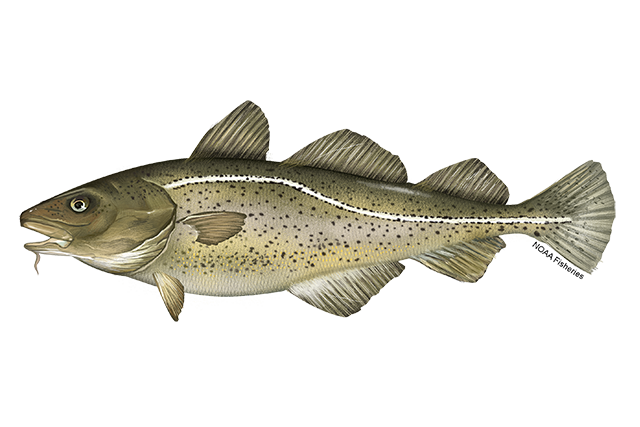
- Picture of Atlantic Cod printed or projected from NOAA Fisheries
- Dried red lentils, dried black beans, dried red beans, dried rice
PROCEDURE
Before the Lesson: Mix the beans and grains into bowls (one bowl for each group)
Introduction:
Begin by showing your class the picture of an Atlantic Cod. An adult female cod can lay 220,000 eggs a year per pound of bodyweight (they can weigh up to 77 pounds according to NOAA Fisheries). That means a large cod could lay millions of eggs.
Connect back to the Fish Lifecycle Game and ask students why they think fish lay so many eggs? What are some reasons that most don’t reach adulthood?
Stories from long ago say that fishermen around Cape Cod could drop baskets into the water, and when they’d pull them back out they would be full of fish. Sailors used to say that you could walk across the water since so many were found in the sea.
Activity:
Explain that your students are now going to run a simulation to show how fishing affects populations of fish in the ocean. Divide your class into partners. One person will be designated as the fisherman for each round, and one person will be in charge of tracking the amount of fish caught. Distribute a bowl (the fishing grounds) full of beans (the fish – you can use different dried beans/lentils/grains to represent different fish if you’d like) to each group, along with a small cup (the boat). For each round, you will distribute a new tool that the fisherman must use to catch the fish.
Draw a key on the board showing what seed correlates to which type of fish.
Tuna = Yellow Lentil
Bluefish = Black Bean
Striped Bass = Red Bean
Cod = Rice
Round 1
For round one, distribute a pair of chopsticks to each group. Explain that for this round, a small village of people that rely on a few spear-fisherman to provide for their community. In this round, fisherman can catch as many fish as they want, but they will need to catch at least 4 tuna (represented by yellow lentils, for example) to make sure everyone in their community is fed. They have 1 minute to catch the fish and put them in their boat. The other members of the team are in charge of counting the number of fish caught, and recording their number once the round is over. Make sure to record the number of lentils collected by the class in round 1. You can draw a table on the board that includes the round number on top, with the types of fish along the side. Collect the chopsticks, and instruct the students to dump their catch from round one back into their fishing grounds.
Round 2
Distribute a small stick (maybe one of the chopsticks from round 1) with a bit of rolled tape on the end. For round two, the fishermen are now using fishing lines with a hook to catch fish. Their community is also bigger now, so fishermen must catch at least 8 bluefish (represented by black beans) to feed their community. Start the exercise again, and make sure the students are recording the type of each fish they catch, especially how many other types besides bluefish are in their boats. Write the numbers on the board.
Round 3
For round three, the fishermen have now started using small nets to catch fish. Distribute a small fork to each group, and tell students that they are now in charge of feeding a whole state of people with their catch. They must now catch 12 striped bass (red beans) to feed their state. Again, record all the numbers of each type of fish caught on your list.
Round 4
For round four, distribute a large spoon to each group. They must now provide a special type of fish, cod, to an entire country. They must now catch at least 20 cod (grains of rice) to meet the demands of their country. Luckily, the fishermen in this round have learned to use giant nets to catch fish, so they can scoop them right out of the ocean. At the end of this round, record all the numbers as usual but instruct your students NOT to return the fish they caught at the end of the round back into the ocean.
Wrap up/Assessment
Have the students change fishermen for this fifth round. Tell them that the country they live in has fallen in love with cod, and fishermen can’t keep up with demand. For this round, the fishermen can catch as many cod as they want, but they must still keep count of what they catch of each type of fish.
At this point in the simulation, take a look around to see what is happening in each group’s fishing ground. Many groups will have no cod left (or very few fish at all) in their bowls. Ask your students to take note of what’s happening in their bowls. What has happened to their cod population? What would next season’s cod harvest look like? Would there be one at all?
Ask your students to then look at the numbers you’ve recorded on the board while you collect materials. Ask them to observe how each method of fishing affected the number of target fish caught, and the number of other species that were accidentally caught. Did some groups feel the need to keep fishing, even though they caught enough to feed their communities? Why or why not?
Look again at the final round. Can the class agree that the final fishing method was the quickest and easiest way to catch a lot of fish?
Think back to the story of cod. By the time the late 20th century rolled around, many cod fisheries were depleted and closed off to fishing. Even though cod lay many eggs, the demand for the fish was so high and fishing methods became so effective that cod have almost reached a point of extinction!
So how do we solve the problem of overfishing? Make a list on the board of all the solutions your students come up with to solve issues of overfishing. Some possible solutions to discuss: (diversify harvested species, allow fisheries to rest, moratoriums, ban certain types of fishing, size limits, etc…). For a real world example, Canada banned cod fishing off of its eastern coast in 1992. Cod are just now returning to the area some 26 years later, and it’s still uncertain if the fishery will ever bounce back to what it once was.
FOLLOW UP & EXTENSIONS
Extension:
- Cod by Mark Kurlansky is an excellent resource for more information about overfishing, and the history of cod fisheries in North America. Pairing this lesson with readings from the book could meet a number of History and Social Science standards for grades 3-5, and ELA standards.
- You could also use this lesson to introduce the concept of overfishing, then use it as a prompt for students to design solutions to the problem. Compare the different solutions and discuss the positives and negatives of each design. (7.LS.2.5).
- Connect fishing principals of the honorable harvest. How can fishermen and people who eat fish consider the honorable harvest?
Follow up:
- Explore the Seafood Watch Guides for the Monterey Bay Aquarium for your region with you class.
- Make sushi with your students or fish chowder
- Learn about seaweed and mulch your school garden with seaweed
- Take a virtual sanctuary 360 dive in a National Marine Sanctuary
MA CURRICULUM CONNECTIONS
5.ESS.3.1 Obtain and combine information about ways communities reduce human impact on the Earth’s resources and environment by changing an agricultural, industrial, or community practice or process.
7.LS.2.5 Evaluate competing design solutions for protecting an ecosystem. Discuss benefits and limitations of each design